

Keeping Supreme Cool Case Analysis
A response to University of Virgina Case: Supreme
Problem: Supreme needs to find a way to restore its cultural relevance and remain cool as the brand matures.
Market Size, Competitors, and SWOT: Supreme is valued at $1 billion and competes within an estimated $200 billion global market spanning streetwear, sneakers, and premium fashion. Competitors range from skate and grunge brands like Vans to culturally driven apparel and sneaker leaders such as Nike and Adidas, as well as luxury houses including Gucci and Prada. Key strengths are a loyal hypebeast following, authentic skate roots, and the ability to drive trends through scarcity and collaborations, while weaknesses include limited defensibility beyond brand equity, reliance on collaborations, IP litigation risk, and constant pressure to remain relevant. Opportunities include amplifying cultural impact through spectacle-driven drops and using private equity backing to expand globally and move toward super-luxury positioning, while threats include PE-driven brand dilution, declining relevance, and an aging audience without strong youth replacement.
Target Market: Supreme’s target market is primarily 18–30-year-old, urban, male-skewing consumers in major global cities, with cross-gender and diverse appeal. Psychographically, customers are status-driven and culturally fluent, valuing authenticity, scarcity, and street-to-luxury signaling over function. Buyer behavior is hype-led: consumers closely track drops, evaluate alternatives based on cultural value and resale potential, purchase quickly during limited releases, and reinforce value through social display or resale.
Market Strategy and 4Ps: Supreme primarily pursues a market penetration strategy, deepening engagement with its core audience through scarcity and culturally driven collaborations rather than broad expansion. Its product strategy focuses on premium, limited-run streetwear where the core benefit is status, the actual product is branded apparel and accessories, and the augmented product is cultural cachet and resale value. Pricing follows a value-based skimming model, supported by scarcity and strong aftermarket demand, while distribution remains tightly controlled through direct-to-consumer flagship stores and e-commerce. Promotion avoids traditional advertising and instead relies on hype, celebrity and influencer evangelists, PR-driven drops, and digital buzz to maintain cultural relevance.
Assessment and Feedback: Supreme’s strategic choice is between becoming purely Hermès-like, producing only ultra-rare, museum-level pieces that maximize prestige but risk losing younger consumers, or leaning fully into an LVMH-style model that allows products at all levels. Supreme should blend both by anchoring the brand at the Hermès level through one-off pieces created for culturally defining figures who actively shape youth identity, such as Kanye West or Colin Kaepernick, and then immediately translating those moments into tightly controlled public drops. A highly visible cultural moment, Kanye wearing a one-of-one Supreme piece at an awards show or Kaepernick appearing in a custom Supreme kit tied to protest, signals that the brand still stands for something rare and defiant, and is followed by a sudden, secret drop inspired by that piece that runs briefly and disappears. This allows younger consumers to feel they are buying a fragment of something historically and culturally significant, preserving Supreme’s premium aura while still enabling scale.
Product Concept: The drop is a rebellion kit anchored by a fist-shaped skateboard deck, an ice-cube helmet, and air fresheners and stickers. The product intentionally blurs the line between sporting goods and protest art, fitting Supreme’s history of turning functional objects into cultural statements.
Target Customer: The primary target is core Supreme loyalists aged 18–30 who are deeply embedded in skate, street, and protest culture. This audience actively amplifies their rebellion through social media. The drop also strategically attracts adjacent youth audiences drawn to activism, rebellion, and viral cultural moments, without diluting credibility among core hypebeasts.
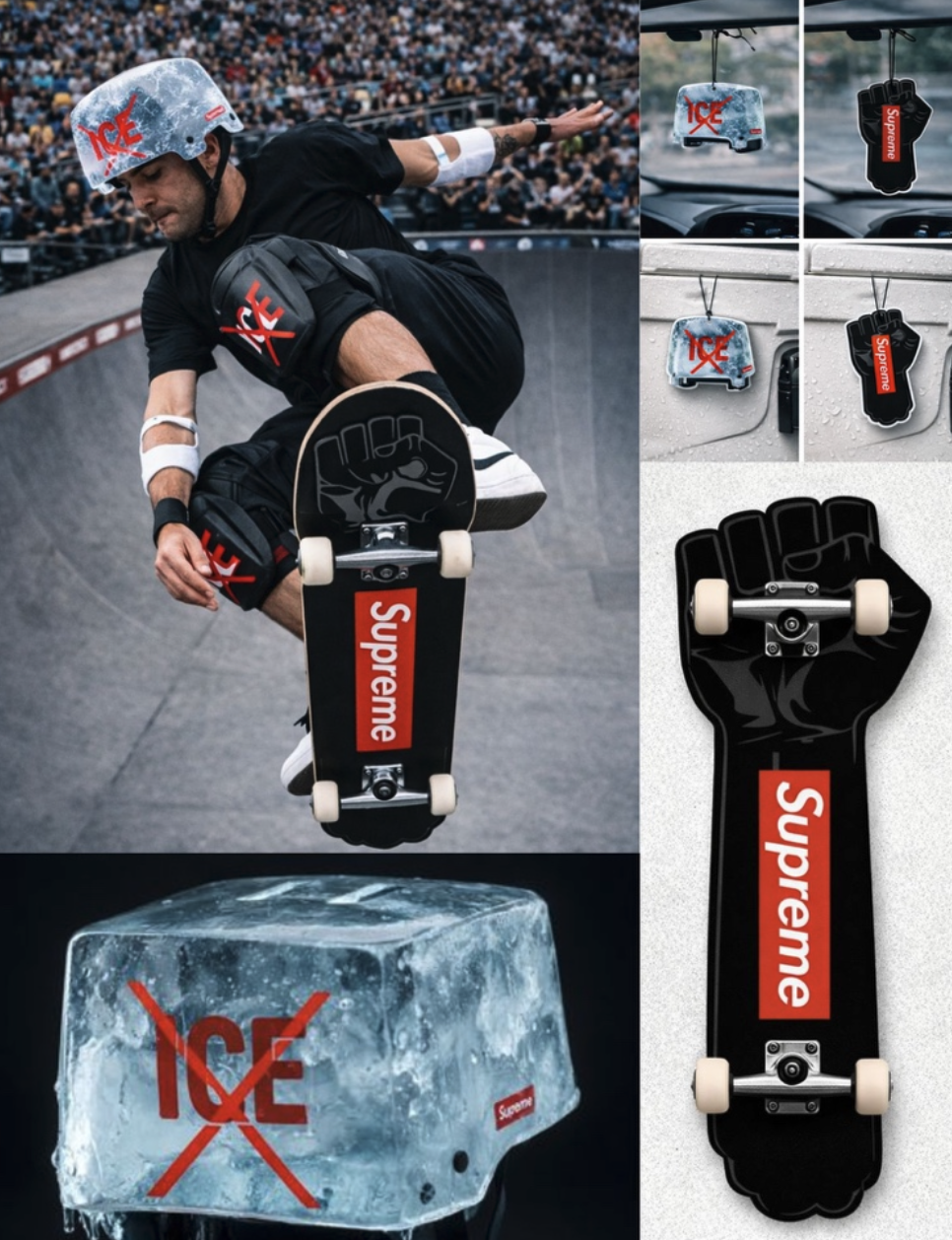
Core Brand Meaning Preserved: This drop reinforces Supreme’s core meanings of rebellion and scarcity. Rebellion is expressed through anti-authority symbolism, protest-linked visuals, and public acts such as tagging a giant street art Supreme ice cube and helmet giveaways. Scarcity is preserved through extreme limits, short availability, and event-based access. Brand dilution risk is mitigated by tying the products to a single culturally legitimate figure and moment, ensuring the message feels earned rather than commercialized.
Pricing Strategy: The helmet is limited to a run of 37 (the age of Renee Nicole Good) and given away for free to attendees at the drop. The fist deck and helmet are priced at premium but attainable levels for core fans, while accessories remain low-cost to maximize cultural spread. Pricing reinforces exclusivity, encourages resale behavior, and positions ownership as participation in a moment rather than purchase of a product.
Intended Product Life Cycle: The product life cycle is intentionally compressed to days, not weeks. The items are designed to sell out immediately following the viral event, transition into resale and archival status, and then disappear. This short life cycle is strategic, reinforcing Supreme’s role as a moment-maker rather than a continuous seller, and preserving long-term brand heat.
Drop Strategy: The drop is triggered by a high-visibility vert competition featuring Paul Rodriguez in the full kit, followed immediately by a Minneapolis skate-park pop-up with helmet giveaways and a large Supreme ice-cube street art installation. A one-week digital campaign amplifies event footage while decks and accessories are released in extremely limited quantities, with helmets given away for symbolism over revenue and the model repeated through future “Ice events” in new cities.